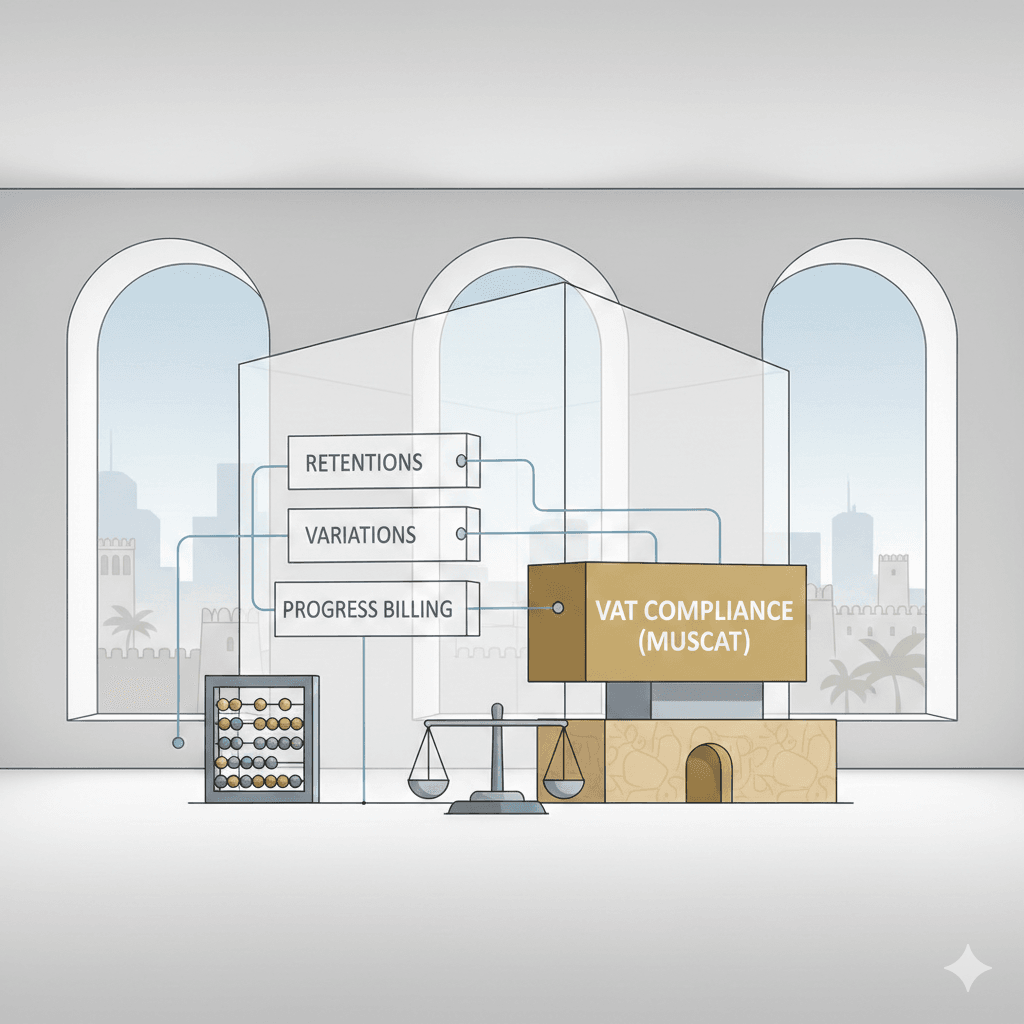
Mutrah Market Financial Controls in the Era of Traditional Trading and Digital Transactions
Mutrah Market Financial Controls as the Foundation of Commercial Stability
Where heritage trading meets modern accountability
Mutrah Market Financial Controls shape the financial discipline that separates sustainable enterprises from fragile ones in the narrow corridors of Mutrah Souq and the expanding mixed-use commercial districts along the Corniche. These controls are not abstract compliance concepts; they represent the daily operational structure through which shop owners, wholesalers, importers, and café operators maintain stability in an environment where cash, credit, and electronic payments coexist. Many SMEs in Mutrah still depend on handwritten ledgers for supplier settlements and daily sales tracking, while simultaneously using modern POS systems for customer transactions. Without an integrated financial control framework, this hybrid model quickly creates gaps between physical cash, digital records, and bank balances. Such gaps expose business owners to VAT misreporting, supplier disputes, inventory distortions, and costly cash leakage that often remains hidden until year-end financial reviews or tax assessments bring the problem to light.
What makes Mutrah distinct is its rhythm. Businesses are influenced by tourist seasons, cruise ship schedules, religious holidays, and import shipment cycles from the Port of Sultan Qaboos. Each of these factors introduces volatility into daily revenue streams. Strong Mutrah Market Financial Controls allow owners to anticipate this volatility rather than react to it. Proper bookkeeping systems transform unpredictable trade flows into structured financial information that supports purchasing decisions, staffing levels, pricing adjustments, and liquidity planning. For SMEs operating on thin margins, this financial clarity is often the difference between expanding to a second location and quietly closing the shutters within two years of opening.
Mutrah Market Financial Controls within Hybrid Bookkeeping Environments
Managing cash culture while adopting digital discipline
Traditional trading culture in Mutrah remains deeply cash-driven, particularly among small traders, gold shops, perfume sellers, and textile merchants. At the same time, Oman’s banking modernization and consumer behavior have rapidly increased POS usage, mobile wallets, and online settlement systems. Mutrah Market Financial Controls must therefore bridge two worlds: manual transaction habits and automated transaction flows. Effective bookkeeping in this environment is not about abandoning tradition; it is about translating it into compliant financial records. Each cash receipt must correspond to inventory movement, supplier obligations, and VAT classification. Each POS transaction must reconcile with daily settlement reports, merchant fees, and bank deposits.
The danger arises when businesses treat these systems separately. Many SMEs track POS sales in software but leave cash movements undocumented or partially recorded. Others reconcile bank deposits monthly instead of daily. Over time, these inconsistencies accumulate and distort the financial picture of the enterprise. Robust Mutrah Market Financial Controls establish a single source of truth by integrating daily cash counts, POS summaries, purchase invoices, and inventory records into one coherent ledger. This integration is the backbone of reliable financial statements, accurate VAT filings, and credible corporate tax computations. For owners who want predictable growth rather than financial guesswork, this discipline becomes non-negotiable.
Mutrah Market Financial Controls and Regulatory Alignment in Oman
Protecting the business from compliance risk
Oman’s evolving regulatory framework places increasing responsibility on SMEs to maintain precise financial records. VAT reporting, corporate tax declarations, and regulatory audits all rely on consistent transaction documentation. Mutrah Market Financial Controls function as the enterprise’s primary defense against compliance failures. When bookkeeping is fragmented, SMEs often underreport revenue unintentionally or misclassify taxable supplies, exposing the business to penalties that can severely strain working capital. In Mutrah’s competitive market environment, such financial shocks can erase years of progress in a single quarter.
Proper controls do not merely satisfy regulators; they empower owners to negotiate confidently with banks, investors, and strategic partners. Clean financial records enable realistic feasibility assessments, credible business valuations, and smooth due diligence processes when expansion, restructuring, or succession planning becomes necessary. Many Mutrah enterprises eventually seek external financing to modernize operations or expand their footprint. Without reliable financial statements supported by strong Mutrah Market Financial Controls, these growth opportunities remain inaccessible, regardless of the business’s underlying commercial strength.
Mutrah Market Financial Controls in Daily Operations and Decision-Making
Turning data into management intelligence
Beyond compliance, Mutrah Market Financial Controls provide business owners with actionable intelligence. Daily revenue tracking, gross margin analysis by product category, supplier cost monitoring, and overhead management all depend on accurate bookkeeping. In Mutrah’s mixed retail environment, where profit margins vary widely between imported luxury goods, tourist souvenirs, and everyday commodities, these insights become essential for pricing strategy and inventory planning. Owners who understand exactly which product lines generate consistent cash flow can adjust their merchandising and marketing strategies with confidence rather than intuition.
Financial controls also strengthen internal accountability. Clear documentation of expenses, payroll, advances, and reimbursements reduces disputes among partners, employees, and suppliers. This clarity becomes increasingly important as family-owned Mutrah businesses transition into second-generation leadership. Formalized Mutrah Market Financial Controls replace informal trust-based systems with transparent governance, reducing conflict and enabling long-term stability. For SMEs preparing for future succession, this transformation is often the most important step they take.
Mutrah Market Financial Controls as a Growth Enabler for SMEs
From survival bookkeeping to strategic finance
Many SMEs initially view bookkeeping as a survival tool, necessary only to meet tax deadlines and pay suppliers. However, mature Mutrah Market Financial Controls elevate bookkeeping into a strategic management function. Forecasting cash flow, planning capital expenditures, and evaluating expansion opportunities all require dependable financial data. When owners possess this clarity, they move from reactive crisis management to proactive growth planning.
This evolution also supports more advanced financial services such as structured advisory, valuation, feasibility studies, and even liquidation planning when market conditions shift. Businesses that maintain disciplined financial controls navigate downturns with far greater resilience than those operating without visibility. In Mutrah’s rapidly changing commercial environment, where tourism cycles, global trade patterns, and regulatory developments constantly reshape demand, adaptability is built on financial insight. Strong Mutrah Market Financial Controls provide that insight.
Mutrah Market Financial Controls and the Future of Omani Commerce
Preserving heritage while embracing modernization
Mutrah stands as a symbol of Omani commercial heritage, yet its future depends on modernization that respects tradition. Mutrah Market Financial Controls represent the bridge between these two forces. As POS adoption expands, digital payments accelerate, and regulatory expectations rise, the businesses that thrive will be those that translate their heritage operations into robust financial systems. This does not diminish Mutrah’s character; it strengthens it by ensuring that its traders remain competitive in a globalized economy while preserving the relationships and customs that define the souq.
For entrepreneurs entering the Mutrah market today, financial discipline is no longer optional. It is the foundation upon which sustainable success is built. Whether operating a single retail stall or managing a multi-branch trading company, the path forward is shaped by how effectively financial controls are embedded into daily operations.
The journey toward strong financial governance is gradual, but its impact is immediate. When SMEs commit to building reliable bookkeeping frameworks, integrating POS data, managing cash rigorously, and aligning with regulatory expectations, they unlock stability, credibility, and long-term growth. In Mutrah, where commerce has thrived for centuries through trust and reputation, modern financial discipline now plays the same role. Mutrah Market Financial Controls have become the new currency of sustainable success.
As Omani SMEs navigate the next phase of economic development, those who invest in financial clarity will find themselves better positioned to expand, attract partners, and withstand market shocks. The businesses that embrace this transformation today will shape the future of Mutrah’s commercial legacy for generations to come.
#Leaderly #MutrahMarketFinancialControls #Oman #Muscat #SMEs #Accounting #Tax #Audit